

 By
By This was originally published as the February 2025 CitSci newsletter. Want citizen science in your inbox? Subscribe today.
Hey!
It’s the CitSci team.
Our Favorite Extreme Sport: Hunting for Microbes
We’ve explored the oceans, outer space…but have we explored our dishwashers and air conditioning trays?
Microbes—tiny living organisms that can only be seen with a microscope—have special talents, like eating carbon dioxide and residing in extremely hot or dry environments. This means that they may hold the key to addressing issues like climate change!
We knew that microbes lived in deep ocean trenches and inside volcanoes, but now, with “The Extremophile Campaign: In Your Home,” you can go hunting for microbes that live in uncharted territory: the nooks and crannies of our own homes, where household appliances create the temperature and moisture conditions that microbes love.
Hosted on CitSci.org and led by The Two Frontiers Project, this participatory science campaign invites you to spend a few minutes to snap a photo of the telltale signs of microbial growth (think slime, crusty mats, or stringy growth) and complete a quick survey.
Scientists will review your data, and if your sample is of interest, you could be sent a sampling kit to contribute to cutting-edge DNA sequencing research!
Where to Look:
- Inside dishwashers (hot and humid!)
- Refrigerator drip lines (cold and wet!)
- Showerheads and air conditioner drip trays
- Other unexpected places where microbes thrive
What are you waiting for? Take action!
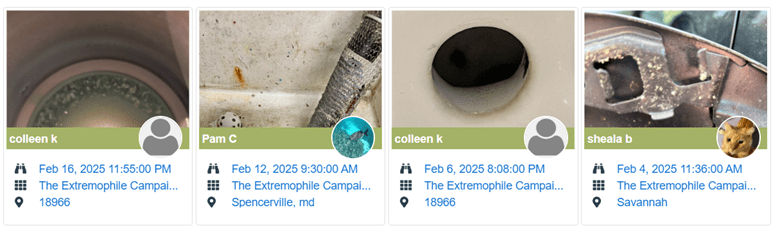
CitSci’s in the News!
Our work with “The Extremophile Campaign: In Your Home” was recently featured in Grist, a leading climate solutions news outlet! The article spotlights how extremophile microbes in dishwashers, washing machines, and even AC units could play a role in capturing carbon. Read the full feature.
Watch an Event Recording

We joined the SciStarter LIVE team on Zoom for a livestreamed event on February 25 at 2 PM ET.
Have questions about “The Extremophile Campaign: In Your Home” or just want a deep dive overview from us? This recording will probably get you the answers you need! Otherwise, just email us: team@citsci.org. We’d love to hear from you.
Community Spotlight: #LeaveNoTrash
This newsletter, we’re spotlighting Zippy R. for their participation in the #LeaveNoTrash project! While cleaning up at Colorado State University, Zippy picked up a grocery bag full of litter, with the most common items being food wrappers, plastic bottles, and paper waste.

The #LeaveNoTrash project is all about understanding and reducing litter in outdoor spaces. By recording what types of trash are most common and where they are found, volunteers help address litter at its source. Plus, every April during Earth Month, the project holds a special challenge to see how much litter can be removed and documented!
Want to make an impact? Join the project today and help keep our environment clean! Open to global participation. Learn more and participate.
Want to see your contribution in the next newsletter? Post to any project on CitSci.org, and you might be our next featured citizen scientist!
Update your CitSci app
We went on a little debugging adventure and completed scheduled maintenance on Jan 15th.
If you use one of our mobile apps, please update it to keep things running smoothly.
If you run into any hiccups, don’t worry—just click the help button in the upper right corner on CitSci.org and let us know!
Welcome, Caroline!

Caroline just joined CitSci to help with communications. Recently, she wrapped up a PhD at the University of Florida, and she comes to us with a background in citizen science outreach (from SciStarter) and civic tech (from Florida Community Innovation).
Her life goal is to empower the public to meaningfully engage with science and technology.
She drafted this newsletter and is currently writing about herself in the third person, so she wants you to know that she is excited to meet you, dear reader, and become part of your community.
Support Students with a Gift
Help us raise $10,000 to support student software developers who want to make a difference! CitSci students gain hands-on experience in participatory science while working alongside experienced developers to improve community projects. Many have gone on to careers in nonprofits, government, and industry.
A gift of $10, $20, or more provides meaningful work and learning experiences for students—and who knows, they might be working for you one day!

 CitSci.org Blog