
 By
By Ever enjoyed an article from the Natural Resource Ecology Laboratory (NREL)’s EcoPress? Then you have Melissa May to thank!
Melissa wears many hats, but we’ll start with her academic one: she is an Ecosystem Science and Sustainability student at Colorado State University (CSU), with a minor in Political Science.
Since moving to Colorado in 2018, she has been inspired by the state’s landscapes and wildlife — and now, she is pursuing a career in which she can help maintain that beauty.
Today, Melissa is making her mark as both a student researcher and a science communicator at CSU’s NREL, a world-renowned hub of ecosystem science that has pioneered ecological modeling, climate change research, and participatory science for more than 50 years.
SUPER & CitSci
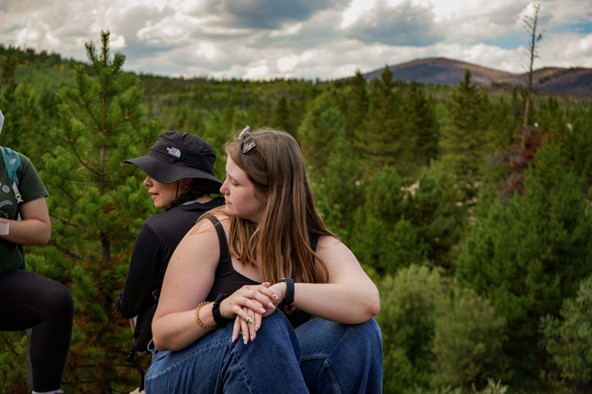
Melissa’s first step into participatory science came through the SUPER Program (Skills for Undergraduate Participation in Ecological Research), which gives undergraduates year-long research experience and faculty mentorship.
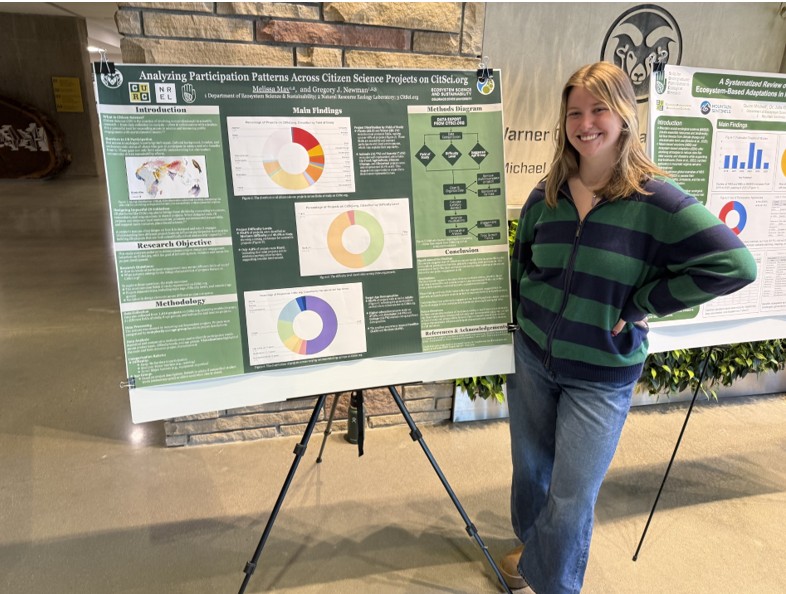
Under the guidance of Greg Newman, director of CitSci and a research scientist at NREL, Melissa analyzed 1,000+ projects hosted on CitSci for trends, classifying them into different categories including topic (e.g. animals, birds), demographic (e.g. college, elementary school), and difficulty (e.g. easy, hard).
Participatory science, also known as citizen science, is the practice of public participation and collaboration in scientific research, often through the collection or analysis of data.
CitSci is CSU’s participatory science platform that has supported more than 15,000 participants worldwide since 2007. Volunteers have contributed nearly 2 million scientific measurements on issues ranging from water quality to agriculture to climate change.
Analyzing these projects gave Melissa new insights into the accessibility and scope of participatory science. “So many projects are easy and accessible,” she explained. “What was most surprising was how much educational citizen science is happening. I was inspired by the teachers who would start projects and collect data about the world around them, alongside their students.”
After finishing this first project, Melissa joined another team helping CSU plan for the upcoming Participatory Science Center, an initiative that will be housed at NREL and led by co-founders Greg Newman, Stacy Lynn, and Sarah Newman. The Center will bring together CitSci personnel, as well as CSU faculty, students, and communities to expand CSU’s leadership in, as Greg said, “science by the people, for the people, and with the people.”
Melissa appreciates the global perspective CitSci empowers. “You can take a water quality sample in your backyard, wherever you are in the world, to make a difference for your community.”
Writing for EcoPress
As mentioned earlier, Melissa is a writer and editor for EcoPress, NREL’s student-driven science communication platform. EcoPress trains students to translate complex research into engaging stories for the public.
Through EcoPress, Melissa has told the stories of landmark ecosystem models, longtime research staff, and creative scientific questions. She values how it captures the culture of NREL: “The people at this lab are some of the coolest ever. They’re cutting edge! On any given day, you’re talking in hallways with Nobel laureates.”
Research in the Nachappa Lab
Beyond writing, Melissa gains hands-on experience in the Nachappa Lab at CSU, where she works as a Laboratory Assistant. The Nachappa Lab studies agricultural ecosystems, plant–insect interactions, and sustainable farming practices.
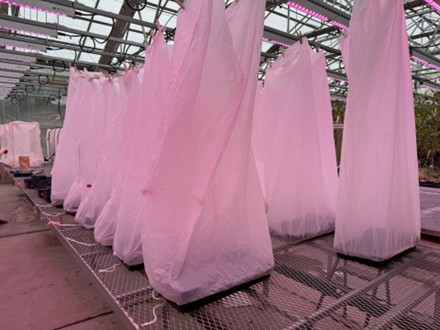
In this role, she is developing skills in agricultural research methods, lab techniques, and applied science, which complement her work in participatory science and communication.
Future Goals
Looking ahead, Melissa plans to pursue graduate study in environmental science and policy.
Her long-term vision is to connect research, communication, and equity, ensuring that climate and ecosystem science translates into tangible improvements in people’s daily lives.
“Understanding the ground-up impact of addressing climate challenges can make a difference in people’s daily routines,” said Melissa. “It shows how many people care about the environment and will make changes in their lives.”
Want to explore the kinds of projects Melissa studied? Visit CitSci.org to join 1,000+ participatory science projects happening around the world today.

 CitSci.org Blog