
 By
By Blog post written by Madison Stroker, CSU undergraduate student & CitSci Support Assistant
Dani Lin Hunter began exploring citizen science – public engagement in scientific research – while a graduate student at Colorado State University (CSU). At first, Dani looked at citizen science with an academic lens, but soon she started to see its potential as a way for local communities to communicate and collaborate with decision-makers.
While at CSU, Dani joined the CitSci team. CitSci is a global platform (hosted at CSU) for people to create, participate in, and explore citizen science projects. At CitSci, Dani focused on understanding how communities use CitSci’s app and website to talk about citizen science and share it with others. Her work explored how effective the platform is at creating a welcoming space for communities to learn about, engage with, and participate in citizen science projects.
Through her research, Dani helped inform the development of CitSci as a platform that empowers community collaboration.
A Career Rooted in Community-Centered Science
CitSci laid the foundation for Dani’s understanding of citizen science and shaped the way she approaches work today. During her time at CitSci, she learned to think outside the box by creatively developing citizen science projects that connect people to meaningful research.
One of the most powerful aspects of citizen science is its flexibility to drive change at the local level while also making an impact on a much broader scale. When we spoke with Dani, she emphasized that CitSci is open to all. “It gives anybody the opportunity to document the data that is of interest.”
Dani now carries this perspective into her current career, where she designs community science projects with the goal of supporting communities in North Carolina.
Post-PhD, Dani has built a career that reflects both her values and her commitment to community-centered work. She works for the North Carolina Environmental Justice Network (NCEJN) as a Research and Education Manager, where she plays a key role in advancing environmental justice initiatives across the state.
Environmental justice ensures that all communities are fairly treated and receive equal access to environmental protection. It provides a voice to all members of the community so they can participate in the development and implementation of environmental laws and policies.
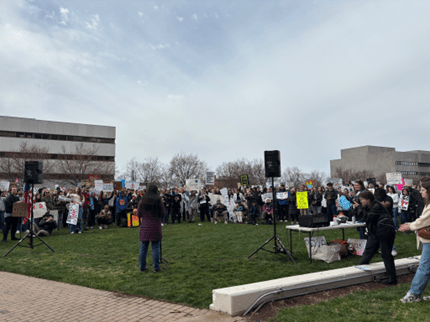
Speaking about the importance of rigorous scientific research for supporting advocacy in environmental justice communities at the Stand Up for Science protest in Raleigh, North Carolina.
In her role, Dani weaves together research and education, two foundational elements of citizen science, in her everyday work. Through meaningful community engagement and the creation of participatory research opportunities, she helps ensure that community members are not just subjects of research, but drivers of the process. This approach empowers communities to generate knowledge, advocate for themselves, and drive environmental change from the ground up.
At the heart of the work at NCEJN is a deep commitment to supporting communities that are disproportionately impacted by environmental injustices. Dani’s role is rooted in listening and learning directly from communities about their research needs and concerns.
From there, she helps bridge the gap between communities with lived experience facing injustice and researchers with the expertise to address those needs. Dani traces her connector skills to her time at CitSci. “One of the things CitSci taught me was to think outside of the box in terms of how citizen science infrastructure can support at a broader scale,” she said.
“One of the things CitSci taught me was to think outside of the box in terms of how citizen science infrastructure can support at a broader scale,” she said.
This collaborative process often takes the form of participatory science projects, where community members are not just observers, but active contributors. By centering community voices in the research process, these projects empower people facing environmental injustices to play a direct role in generating knowledge, advocating for change, and shaping solutions that affect their lives.
Empowerment Through Education
Education and communication are central to Dani’s work. She uses her science communication skills to help marginalized groups understand, collect, and use data as a tool for advocacy. By making scientific information more accessible, she supports communities in strengthening their voices and advancing environmental justice efforts.
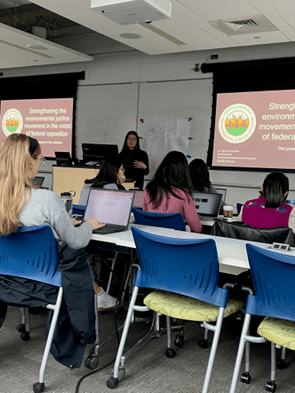
Dani giving a guest lecture to Duke University students on the power of combined research and organizing to support environmental justice communities.
One upcoming project she is especially excited about will use the participatory science platform, Zooniverse, to crowdsource the locations of unpermitted animal agriculture operations.
This initiative will actively engage the public in identifying and documenting these injustices, giving community members a tangible way to contribute to accountability and change. The project will launch at the county level, with plans to expand statewide, amplifying its impact and reach.
Turning Uncertainty Into a Purpose‑Driven Career
Want to have a career like Dani’s, but feel intimidated by the scope of such important work? Dani told us not to be afraid. “It’s okay to float a little bit and not have everything mapped out, because I absolutely love my job. I feel like I get to use all my skills, and I get to do all of the things I love.”
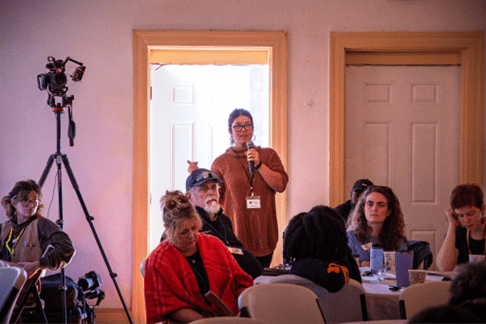
Dani sharing about the possibility of participatory mapping to support community-based research in environmental justice communities at NCEJN’s annual summit
Through her academic and professional journey, Dani has come to realize there is no need to have every step of your path mapped out. Life is not linear, and the twists along the way often lead to the most meaningful opportunities.
“It’s okay to float a little bit and not have everything mapped out, because I absolutely love my job. I feel like I get to use all my skills, and I get to do all of the things I love.” – Dani Lin Hunter
By staying committed to her passions, Dani has found herself in a role she genuinely loves and allows her to apply her skills while contributing to research she truly cares about. Her story is a reminder that patience, curiosity, and hard work can open doors to opportunities you never expected, but end up being the perfect fit.
Learn from Dr. Hunter
What’s in a name? The paradox of citizen science and community science
More research by Dr. Hunter on ORCID

 CitSci.org Blog