
 By
By Blog post written by Madison Stroker, CSU undergraduate student & CitSci Support Assistant
CitSci introduced Ellen Eisenbeis to citizen science – real science anyone can do, usually by collecting or analyzing data – as she finished up her undergraduate degree in Ecosystem Science and Sustainability at Colorado State University (CSU).
Ellen was deeply interested in both the environment and policy. From an environmental perspective, policy involves the regulations and practices adopted by governments and organizations to help manage human impacts on the natural world.
Ellen quickly discovered that citizen science can serve as a bridge between environmental challenges and decision-making, by fostering relationships between citizens and policymakers.
At CitSci, Ellen assisted the communications team with a variety of tasks. She created blog posts such as Developing an Effective Research Question, and talked with users about how the platform can improve specific features and tools, such as the datasheet creator and forum, to better suit their needs.
Storytelling, in a New Way
Working with CitSci’s communications team, she began to see storytelling in a new way. Rather than just sharing information, she conceptualized storytelling as a dialogue with the audience: meeting them where they’re at, and learning from them, too.
At CitSci, she learned to craft pieces that do just that. This foundation in thoughtful, audience-centered communication didn’t stay behind when she moved on. It is a skill she continues to apply everyday in her work now.
Ellen writes for all audiences. “When I’m writing papers, I’m writing them not only for college students, but also all the way up to state legislators or regulators that are going to have a different level of interest,” said Ellen.
Ellen traces much of her professional growth back to her work with CitSci. It was here where she developed the science communication skills she now uses everyday. CitSci taught her that decision-making isn’t all about data collection on its own; it’s about how you communicate data and information to the public, as well.
“With CitSci, you can understand how individuals and communities look at an issue,” said Ellen.
Where is She Now?
After graduating from CSU in 2018, Ellen moved to Washington, D.C. to pursue her interests in policy and law. There, she worked as a Legislative Intern for the U.S. House of Representatives Committee on Energy and Commerce.
“I worked for the Democratic staff and the work was hard, but certainly worthwhile,” said Ellen. “It was a really great learning experience. I really discovered that I do love policy and law cases, and seeing how the process works out.”
Eventually, she missed Colorado and moved home. Bringing her federal experience with her, Ellen attended graduate school at the University of Denver, and then joined the Center for the New Energy Economy where she began as a Graduate Research Intern before becoming a Research Associate and most recently a Policy Analyst. Her work at the Center focuses on energy policy research and the creation of publicly available energy policy specific tools and resources.
As a policy analyst, Ellen spends her days reviewing legislation from all 50 states, and writing policy briefs for state legislators, regulators, and agency staff. This work requires that she analyze, organize, and communicate information in a manner that is both accessible and actionable.
Ellen’s work frequently covers such topics as advanced energy, climate adaptation, infrastructure, building energy efficiency, and emissions.
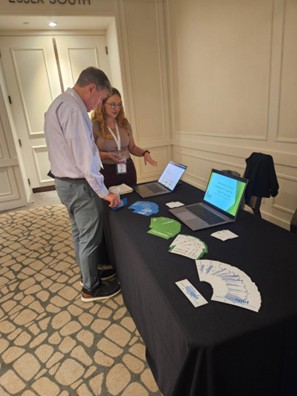
Ellen talks with a state legislator highlighting the Center’s legislation tracking tools – AEL Tracker and SPOT for Clean Energy.
This supports decision-making among policy leaders, experts, and communities. By synthesizing the legislation that is introduced, enacted, or failed, she helps state policymakers build smarter, more informed climate and energy policy.
For Ellen, it is the interconnectedness between energy, climate, and the community that makes this work meaningful.“I don’t think that you can disconnect energy from climate,” she said. “You can’t disconnect climate from adaptation. And you can’t disconnect any of it from emissions.”
In her view, energy, climate, adaptation, and emissions are all parts of the same system. When you make a change in one area, like switching to cleaner energy or improving how communities handle climate impacts, it sets off changes in others too, affecting emissions levels and how people and environments respond.
From CitSci to Today
Citizen science, she explained, bridges environmental challenges and decision-making while also giving communities a voice in addressing the issues that affect them directly. According to Ellen, when a leader understands how individuals and communities perceive a problem, they can communicate solutions in ways that actually resonate with intended audiences.
“Every audience is different, so you have to be able to find the broadest idea that you can communicate for everybody, and then be able to funnel it to different groups so that everybody can get what they need out of it,” said Ellen.
That mindset now serves as a guide for her professional work. On any given day, Ellen might be speaking with college students, providing information to state legislators, or working with state regulators. Each audience requires a different tone, vocabulary, and framing, but the core message remains grounded in clarity and accessibility and focused on action-oriented solutions.
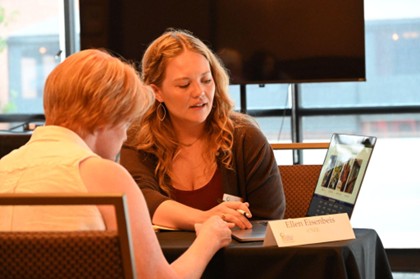
At the 2025 Clean Energy Legislative Academy, Ellen sits in a 1-on-1 with a state legislator to discuss legislative opportunities identified during the Academy and the Center’s legislation tracking tools such as the Advanced Energy Legislation Tracker.
Working with Communities in Transition
A particularly meaningful part of Ellen’s work focuses on energy communities in transition, specifically those shifting from coal based economies to more diversified and sustainable futures. These communities are historically tied to fossil fuel industries or are located near sources of harmful pollutants. In these communities, state and local policymakers make decisions that affect daily quality of life.
The Center aims to help these communities navigate economic and environmental shifts by providing support and resources as they move away from a coal based economy, while centering public health, long-term sustainability, and economic diversity.
These communities often rely on coal for jobs and local revenue, so the Center’s work can help them plan for change, highlight community voices, and find funding opportunities. It reminds us that climate and energy policy isn’t just about reducing emissions; it’s also about people, their livelihoods, and the places they call home.
If community voices aren’t consulted, Ellen explained that projects can be derailed. “I think we have to pay attention — as scientists, as policy experts, as legislators, as regulators — to the fact that communities have these opinions and that they do have the power to stand in the way of things, particularly when they are not consulted.”
From CitSci to policy, Ellen’s approach remains the same. Listening to community needs, translating complex ideas, and designing inclusive climate solutions are important for assisting these communities in transition.
Empowering Future Scientists
Real change begins when we recognize the connections between ecosystems and communities. When environmental and human health are linked, challenges become more personal, especially when they are framed around people’s values and interests such as skiing or hunting.
Turning research into action depends on clear communication across different audiences. Scientists must translate complex ideas in ways that resonate with communities, students, and policymakers, making communication the bridge between climate and action.
As Ellen put it, “There’s really no job anymore where you can get away with not having to think about a social impact, and I think that’s a good thing. I think CitSci does a good job preparing you to think broadly about how you might get people’s input better.”
Together, these ideas highlight that environmental careers require not just scientific expertise, but also social awareness, collaboration, and a strong connection to the people being impacted by the work.
“There isn’t really a realm of environmental science that you’re going to go into that doesn’t impact communities, and doesn’t impact individuals,” said Ellen. “Being able to look at how communities and how citizens are looking at an issue and approaching it, is really important.”

 CitSci.org Blog